

There’s no such thing as the perfect prospecting system.
Anyone trying to sell you one is full of it.
What I can give you is as close to perfect as I’ve ever seen, built on a principle that governs every successful business development effort in this industry, and probably every other one too.
The field is king. Iteration is its queen.
No matter how airtight your system looks on paper, the only thing that tells you whether it actually works is the market. Not a focus group of one. Not your gut. Not the flavor-of-the-month “goo-roo” on LinkedIn who’s never made a placement in his life.
The market.
And the only way to learn from the market is to apply the Scientific Method to everything you do.
Hypothesis. Action. Feedback. Iteration.
Tweak your messaging. Field-test it with a real sample size. Measure the results. Make adjustments. Run a new experiment. Repeat until you’re deadly.
Sounds simple. Almost no one does it.
I’ve watched recruiters spend more time debating whether cold email is dead than they spend actually improving their cold email. The irony is lost on them.
The Pattern That’s Killing Your Practice
Most recruiters don’t fail because they’re bad at recruiting.
They fail because they’re running a business with no real engine underneath it.
When the market’s hot, deals come in. When it’s cold, everything dries up. And instead of examining the structural problem, they do what this industry has always done: work harder, dial more, blast more emails, pray the volume covers for the lack of strategy.
I’ve watched it burn recruiters out for 25+ years. It burned me out too.
You develop a script you think is original. But really it’s just a variation on the same thing every other recruiter in your niche is saying:
“I’m a [fill-in-the-blank] specialist!”
“I’ve got [pick a number] years in the business!”
“We really understand our clients’ culture!”
And then you blast it out.
A hundred LinkedIn connection requests with the same canned opener.
A hundred cold emails that read like they were written by the same recruiter who’s been copying the same template since 2015.
The occasional phone call thrown in for good measure.
And what do you get? A handful of “not interested” replies, a lot of silence, and the rare hiring manager who actually picks up only to tell you they don’t have needs, they already have recruiters, or you need to go through HR.
When you finally get someone live, the first thing they ask is: “What’s your fee?”
Because you’re selling a commodity. The same commodity a hundred other recruiters in your niche are selling, many of whom hit that same prospect that same week.
This is what I call Spray ‘n’ Pray. And it is the single fastest path to burnout in this business.
You get the feast-and-famine cycle. Great months followed by brutal ones. The constant oscillation between high highs and desperate lows that makes it impossible to think strategically, let alone build something that lasts.
You wake up Monday morning with no calls booked, pipeline empty, a fall-off that just wiped out your projected income.
You check the bank account before you check your email.
You’re doing the math in your head before your feet hit the floor.
That’s not a business. That’s a lottery ticket.
And most recruiters are still playing the lottery.
This is the Red Queen Effect. Always running faster just to stay in the same place.

The recruiters who break out of it aren’t the ones who outwork everyone else. They’re the ones who apply curiosity and iteration to their craft. They test. They adjust. They test again. They move past blindly following templates into a genuine understanding of human nature and the principles of influence.
That’s how you escape. And that, my friend, is freedom.
The Paradox Nobody Talks About
Our business has a fundamental problem that almost no one in this industry will say out loud.
It is far easier for the average recruiter to cold-recruit an executive decision-maker with a job in hand than it is for that same recruiter to cold-approach that same executive to sell their service.
Same recruiter. Same executive. Same phone call, essentially.
The only variable is what you’re calling about. And if that’s the only difference, then the problem isn’t the market, the economy, or how busy and guarded hiring managers have become.
It’s a skill gap. And a mindset gap.
That’s exactly why prospecting is the first thing veteran recruiters abandon. Years of supplicating, begging for job orders, trying to prove you’re good enough. It takes a toll. Calling with a candidate in hand is easier because it takes the focus off you. It removes the risk of rejection.
It also keeps you permanently dependent on having a job order to hide behind.
The recruiters who are still standing five years from now won't be the ones who worked hardest. They'll be the ones who built something that didn't require them to white-knuckle it every month.
And that pressure isn’t going away. If anything it’s intensified. AI is automating the transactional middle of recruiting. Email deliverability is harder than it was three years ago. The market is flooded with recruiters competing for fewer open roles and tighter client budgets. The old methods of cold outreach, hustle, and hope are showing their cracks in real time.
The window to build something real is not getting wider.
Your Crucible
There’s no magic pill. I want to be straight with you about that.
Developing the ability to influence, and the mindset to prospect consistently, takes time. It takes going through what I call the Crucible.

I enlisted in the US Army at 17. First major inflection point in my life. The person who walks in is not the person who walks out. That experience is designed to break you down and rebuild you into something harder. Something more capable than you believed possible.
For others the Crucible looks different. Parenthood. Loss. Conquering a disability. In my case, a severe speech impediment called verbal apraxia that made getting through a sentence under pressure its own act of will. I picked recruiting, the one career that would force me to talk for a living, because I refused to let the thing I was supposedly worst at decide my life.
Whatever form your Crucible takes, it’s the struggle that creates you.
Lack of struggle makes us soft. Without resistance, we trend toward entropy. We need mountains to climb. Without one, we coast toward the version of ourselves we were trying not to become.
Prospecting is your next mountain.
If you commit to the process, apply the Scientific Method, and are willing to live outside your comfort zone, your ability to influence will catch up. Your mindset will catch up.
It 100% will. But you have to go through the Crucible first.
Prospecting Is Non-Negotiable
Prospecting is the literal lifeblood of your practice. Now more than ever.
Follow the chain.
Not prospecting means no leads. No leads means no sales calls. No sales calls means no new clients. No new clients means total dependence on legacy clients. And when legacy clients dry up?
You’re screwed.
Think of yourself as a gold prospector who gets up every single day and goes panning before anything else. Rain or shine. Good mood or bad. Full pipeline or empty.
The recruiting gods are watching, and they are a spiteful lot. They will remember that you didn't do your work.
Find a veteran recruiter who let their practice slip because they felt they didn’t need to prospect anymore. Ask them what they’d do differently. You already know the answer.
Even if you think you don’t need it right now. Even if you have a whiteboard full of job orders. Even if referrals are coming in. Even if business feels fine.
Fine is a trap.
The moment you stop prospecting, you’ve started the clock on your next crisis. You just don’t know it yet.
The Referrals-Only Trap
I eat my own cooking. Always have. My team runs outbound every single day inside The Digital Headhunter: cold email, LinkedIn, the works. If I’m going to teach it, I’d better be damn good at doing it myself.
So in the course of my own prospecting, I occasionally get replies like this:
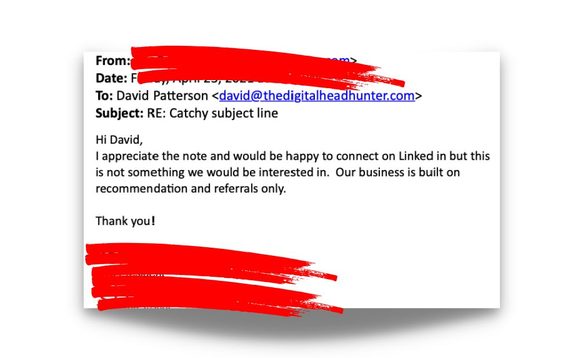
I’m not picking on this person. She was perfectly pleasant. But I recognize the pride underneath that reply.
“We don’t have to prospect. We’re just that good.”
Here’s the question worth sitting with: if an investor were evaluating your business, one of the first things they’d ask is how you predictably take your service to market and find new clients.
If your answer is recommendations and referrals only, you’re screwed. Not today, maybe. But someday. When legacy clients retire or get acquired. When the economy turns. When your niche contracts. When the one client carrying 40% of your revenue decides to build in-house. When AI makes it easier for companies to justify not using external recruiters at all.
If you can’t go to market predictably under your own power, you are one bad quarter away from a crisis you didn’t see coming.
The lion is proud. But the lion also knows it has to hunt.
The lion that has run countless prospecting campaigns, taken the hits, adjusted the approach, and kept showing up, that lion feasts when every other predator is starving. Not because it’s the biggest. Because it never stopped hunting.
Your client acquisition strategy cannot rely on your clients to do your selling for you.
That’s not a business. That’s a prayer.
All joking aside. The recruiters who are still standing five years from now, through AI disruption, fee compression, market contractions, and whatever else this industry throws at us, will be the ones who never stopped hunting. Not out of desperation.
Out of discipline.
The phone call nobody wanted to make turned out to be the one that changed everything. It usually does.
In Part 2, we get into what actually makes prospecting work or fail at the execution level. Spoiler: it’s not the channel, the volume, or the platform. Read Part 2: The Secret to Prospecting