

If Part 1 was the philosophy, this is the execution.
And I’m going to open with a confession.
After 25+ years in this business, building and scaling two 7-figure search firms, training 600+ search firms across six continents, and running outbound campaigns every single day inside The Digital Headhunter. The single biggest prospecting killer I see has nothing to do with volume, channel, or technology.
It’s the copy.
Specifically: the absence of foundational copy. Or worse, copy that was written once, never tested, never updated, and never improved upon.
Most recruiters start prospecting before they’ve done the work. They grab a generic template from a “goo-roo” selling scripts, blast it out, wonder why nobody’s responding, and conclude that prospecting doesn’t work.
Cold email is not dead. Your cold email is dead. There’s a difference, and it matters more than most recruiters want to admit.
Prospecting works. Their copy doesn’t.
The Biggest Prospecting Killer Nobody Talks About
Let me show you what I mean.
Here’s the kind of advice that gets shared in recruiting Facebook groups as if it were gospel:
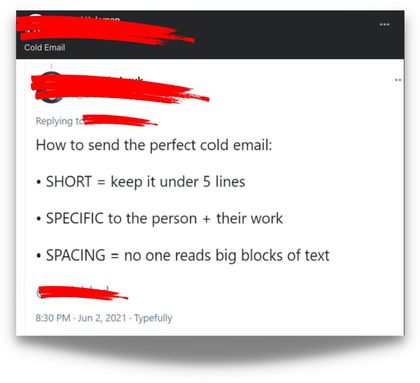
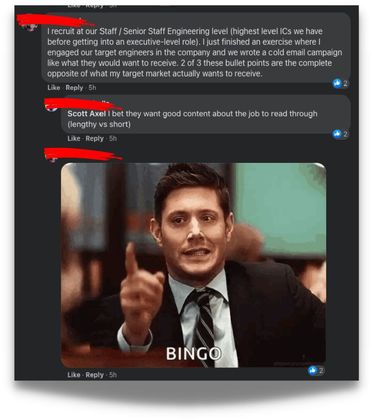
Do you see how pernicious that first rule is?
Sure, you shouldn’t prattle on needlessly. But if everyone is sending the same boring four or five line emails, how are you going to stand out? The recruiter responding to that post gets it. He actually listened to his market and knows what they’ll respond to.
But here’s where it swings too far the other way.
Does that mean I support word-salad emails like this one I received a few years back?
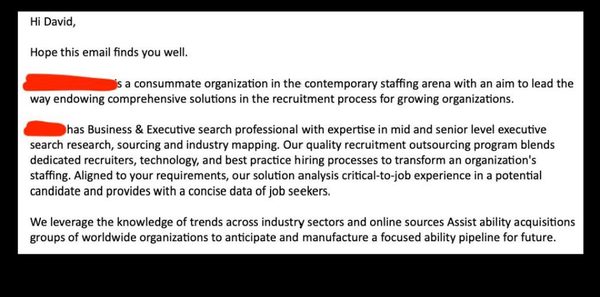
Care to take a guess as to why this email stinks more than a Tauntaun sleeping bag on a camping trip to the ice planet Hoth?

It does nothing to speak to what the recipient needs. A shorter email that actually addressed specific pain would have been far more effective. Both examples fail. One is too short and generic. The other is a word-salad fever dream that speaks to nobody.
Length isn’t the issue. Relevance is.
Your foundational copy is the argument for why your prospects should use you instead of every other recruiter in their inbox. Without it, volume is just noise at scale.
No matter how sophisticated your omnichannel approach is, if your foundational copy isn’t dialed in, your prospecting will fail. Full stop.
The most effective messaging I’ve ever used didn’t come from trainers selling scripts. It came directly from the mouths of the hiring managers I talked to. It came from listening to the market, actually listening, and reflecting that language back in everything I sent.
That’s the secret. Not very sexy. Which is probably why almost nobody does it.
Your Avatar Isn’t Who You Think It Is
Most recruiters think their avatar is a demographic. Mid-level VP of Engineering in the SaaS space. Director of Operations at a mid-market manufacturer. COO at a private equity-backed portfolio company.
That’s not your avatar. That’s a job title.
Your real avatar is a pain state.
Pain is what drives decisions. Pain is what makes someone pick up the phone at 6 PM on a Friday. Pain is what justifies your fee and creates genuine urgency.
Real pain in recruiting looks like this:
The CFO walks into the CEO’s office at 4:47 PM on a Friday. “Our VP of Sales just resigned. He’s taking two top performers with him. The board meets in two weeks and they’re going to ask about Q4 revenue projections.” The CEO cancels his weekend. Again.
That’s pain. That’s a real client. That’s someone who will take your call, engage with your process, pay your fee, and remember you the next time it happens.
Time-to-fill is not pain. Wanting to hire better talent is not pain. Being open to recruiters is not pain.
In order for your ideal client to pay you any mind, they have to be feeling sharp business pain that can be solved by the right application of talent. And they either need to be actively looking, or at least have the ability to act.
If you’re spending most of your time selling to prospects who don’t meet that bar, you’re not prospecting. You’re wishing.
The 3% Reality
Here’s a number worth understanding.
At any given moment, roughly 3% of the hiring managers in your target market are feeling acute pain. They’re the ones who need you right now. The ones who will respond, engage, and move.
The other 97% fall into three buckets: no current need, a need but no urgency driving it, or perfectly happy with their current recruiter and nothing you say today is going to change that.
So here’s the question: can you tell which three out of every hundred prospects are feeling that pain right now?
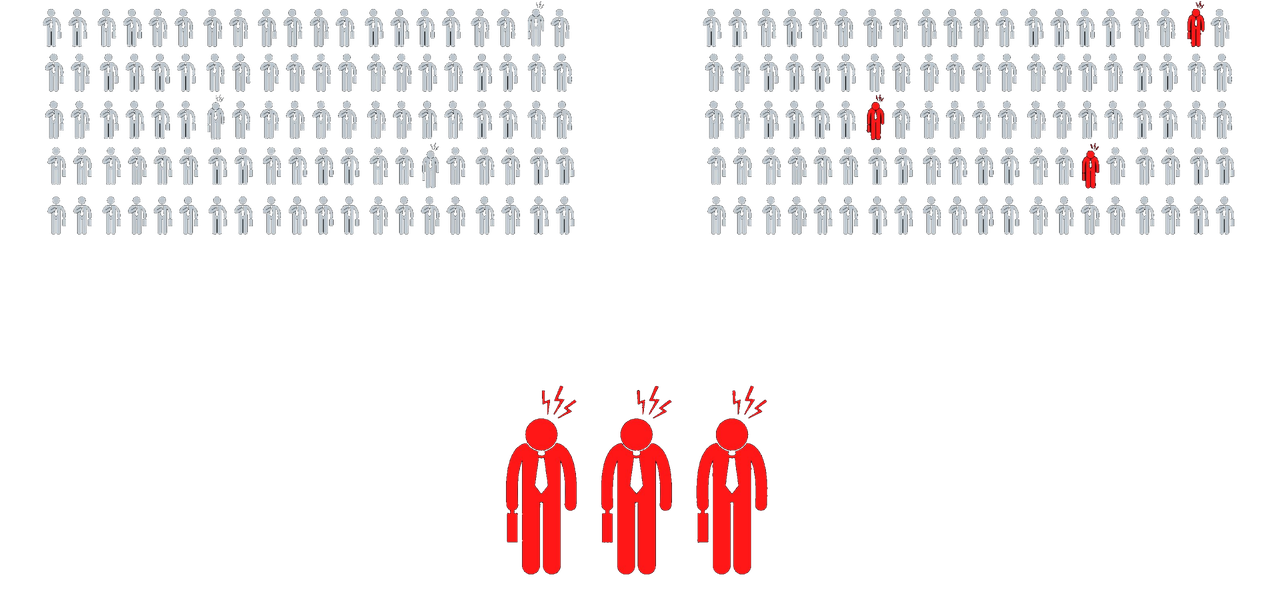
Now you can see them.
That’s what a properly built prospecting system does. It agitates the herd. It creates enough relevant, well-sequenced touchpoints that the 3% who are in pain identify themselves through replies, clicks, and conversations. And it keeps you in front of the other 97% so that when their pain arrives, you’re the name they already know.
The lion doesn’t chase every zebra in the herd. He stalks. He watches. He identifies the ones that offer the best chance of success and commits his energy there. He ignores the rest, for now.
That’s how you build for the future while closing in the present.
Triggers: Finding the 3% Before They Raise Their Hand
Here’s where modern tools change the game entirely.
You don’t have to wait for the 3% to respond to your outreach. With the right data intelligence, tools like Clay and similar platforms, you can identify them before they ever pick up the phone.
The most powerful triggers to build into your prospecting system:
Role changes. An executive who just stepped into a new position in the last 30 to 90 days is one of the highest-probability prospects in your entire market. They’re building their team. They’re inheriting problems. They’re under pressure to prove themselves fast. They need talent and they need it now. Clay tracks these changes in real time and surfaces them automatically.
New job postings. When a company posts a role in your niche, that’s a live signal of active pain. They’re hiring, which means they have a need, which means they’re a qualified conversation waiting to happen. A well-built system alerts you the moment that posting goes live so you’re calling first, not fifth.
Funding rounds and growth signals. A Series B announcement almost always means a hiring wave is coming. Getting in front of the right people before the wave hits puts you in a completely different position than every other recruiter showing up after the fact.
Leadership exits. A VP or C-suite departure creates immediate organizational pain. Someone has to backfill. Someone has to hold the team together. Someone needs a recruiter who knows the space.
When you build these triggers into your outbound system, you stop randomly agitating the herd and start identifying the wounded zebra before anyone else sees it. You’re not interrupting. You’re arriving at exactly the right moment.
The Hunting + Farming Framework
There are two types of prospecting activity. Both are non-negotiable. Both must happen every single day.
Hunting is everything outbound. LinkedIn outreach, cold email, warm calls, direct mail. Every proactive effort to get in front of a decision-maker and start a conversation. Hunting pays the bills.
Farming is everything that builds your presence. Content, thought leadership, your point of view in the market, the material that nurtures trust over time. Farming warms the soil so hunting produces better results.
Most recruiters do one or the other. The ones doing only farming post content and hope somebody calls. Nobody calls. The ones doing only hunting blast generic outreach into a cold market and wonder why nothing converts.
Farming makes hunting easier. When a hiring manager receives your LinkedIn connection request and already recognizes your name from content they’ve seen this month, that’s a warm call, not a cold one. Your farming did the setup. Your hunting closes the gap.
They must happen together. Every single day.
The Personalization Spectrum
Not all outreach is created equal. Think of personalization as a spectrum, with full automation on one end and complete hyper-personalization on the other.
At the automation end: you’re blanketing the market. High volume, lower response rates, but it scales. This is your bread and butter for consistent pipeline coverage across hundreds or thousands of prospects.
At the personalization end: you’re spearing. Low volume, dramatically higher response rates, reserved for your highest-value targets. The more sophisticated the buyer, the more personalized your approach needs to be.
The smartest prospecting systems move between both. You blanket to cover the market. You spear to crack the toughest doors.
Here’s what that looks like across the spectrum:
Fully personalized emails. It used to be enough to write a personalized first line and let the rest of the email run on automation. Those days are largely gone. The recruiters winning right now are personalizing entire emails for their highest-value targets, referencing specific things about the company, the leadership team, recent news, market dynamics, the prospect’s own background. The whole message feels written for them and only them. It takes more time. It converts at a completely different level.
Personalized first lines at scale. For broader outreach, a first line written specifically for each prospect, something real about their company or recent activity, boosts reply rates two to five times compared to generic openers. With AI and a solid VA setup, you can do this across hundreds of prospects without it consuming your week.
The phone. I know. Everyone wants to talk about the latest digital channel.
There’s a special place in recruiting hell reserved for the guy who reads a book about personalization and then sends the same “Hi [FIRST NAME]” email to 500 people.
The phone is the original personalization tool. It’s a human voice. It’s real-time conversation. It’s the one channel where you can hear the tone shift when you’ve hit a nerve, pivot in the moment, and build genuine rapport in sixty seconds that no email sequence can replicate. Most recruiters are hiding behind LinkedIn automation and email sequences. Which means the phone is actually less crowded than it’s been in years.
Use it. Your farming and your digital touches make those calls warmer. Pick up the phone. It remains the most powerful personalization tool in the toolkit, because it’s you. Unfiltered. In real time. No algorithm between you and the other human being on the line.
LinkedIn voice notes and video messages. Most recruiters are firing off text messages into a sea of text messages. A 30-second LinkedIn voice note or a short personalized video cuts through instantly because almost nobody else is doing it. It signals effort. It signals you’re not a bot. It gets listened to.
The Spear technique. Record a short screenshare video with their LinkedIn profile or company website as the visible background. Send it via email or LinkedIn. They see their own profile on the screen in the preview thumbnail and they click. Every time. It’s one of the highest-converting outbound tactics in the toolkit right now and the vast majority of recruiters have never tried it.
Image and website hyper-personalization. Personalized images embedded in emails, showing the prospect’s name, company logo, or a relevant visual, serve as a pattern interrupt in an inbox full of text. Website personalization goes further: when a prospect clicks a link in your sequence and lands on a page that displays their name and company, the psychological impact is significant. It signals research. It signals care. It makes them feel seen rather than spammed.
Going All the Way
And then there are the plays that exist at the far end of the spectrum.
The ones that cost more, take more effort, and produce conversion rates that no automated campaign can touch.
One of our clients sends curated gift boxes to a carefully selected list of high-value prospects.
Each box contains quality items, with a portion of the proceeds going to a charity relevant to the recipient’s industry or interests. Inside the box is a handwritten personalized note and a QR code.
When the prospect scans it, they land on a custom page built specifically for them: testimonials, a client logo reel, and a personal video she recorded just for that individual.
Not AI-generated. Not a template. Her, on camera, speaking directly to that person about why she reached out.
The response rates are extraordinary. The meetings that come from it are pre-sold before they start.
Another client targets executives who have stepped into a new leadership role within the last 90 days, identified through role-change tracking via Clay.
His opening move is to send them a physical copy of The First 90 Days by Michael Watkins, the definitive playbook for navigating a new leadership position, with a personalized note explaining why he thought of them and why now is the right time to connect.
No pitch. No ask for a job order. Just a genuinely useful gift delivered at exactly the right moment in that executive’s career.
The meetings book themselves.
Neither of these works without the targeting intelligence to identify the right people at the right time. That’s what modern tools make possible. The creativity is yours. The data is the enabler.
The goal at every level of the spectrum is the same: make the prospect feel like you did your homework, you understand their world, and you're not just another recruiter blasting their inbox.
The Modern Deliverability Reality
Here’s something the original version of this framework didn’t have to contend with, and that you can’t afford to ignore.
Cold email deliverability has fundamentally changed. Gmail, Outlook, and other major providers have dramatically tightened their filtering. They’re looking for patterns: cookie-cutter messaging sent at volume from the same domain, and they’re killing it before it ever reaches the inbox.
If your outbound email setup isn’t built correctly, your copy doesn’t matter because nobody ever sees it.
The infrastructure basics that are now non-negotiable: alias domains so you’re not burning your primary domain reputation, multiple warmed email addresses per domain, spintax to add variation across your sequences so every message looks unique to email service providers, clean and verified prospect lists to keep bounce rates down, and a sequencing platform that rotates across your inboxes intelligently.
Do this right and you can achieve open rates between 45 and 70%. Do this wrong and you get blacklisted, starting over from scratch on a new domain while your competitors are still in the inbox you just lost.
This isn’t the fun part of building a prospecting system. It’s the infrastructure nobody sees. But skipping it is the equivalent of writing the best copy in the world and then not buying any media to run it.
The Touch Strategy
Think of every message you put in front of a future client as simply a touch.
A LinkedIn connection request. An email in a sequence. A voice note. A piece of content in their feed. A targeted ad. A follow-up call three weeks after an initial reply. A gift box with a QR code. A book delivered on day 30 of someone’s new role. A phone call that catches them at exactly the right moment.
Each one is a touch. Each one compounds.
The goal of any individual touch is not to close a deal. It’s to move the prospect one step closer to a conversation. And if they’re not ready yet, to keep you top of mind until they are.
If they’re not feeling pain right now, there’s nothing you can sell them. Your job is to find the ones who are, stay systematically in front of the ones who aren’t, and be the first name they think of when their situation changes.
That’s the whole game. Not tricks. Not hacks. Not the latest AI tool promising to book twenty meetings a week on autopilot.
Relevant copy. Focused avatar targeting. Smart trigger-based outreach. A personalization strategy that matches the sophistication of your buyer. The phone, used without apology. And the discipline to iterate on all of it, every single day, based on what the market is actually telling you.
The recruiters getting crushed right now are the ones still looking for the magic script.
The ones thriving are the ones who did the work to understand their market’s pain at a deep level, built their messaging around it, built the infrastructure to deliver it, and then got genuinely creative about how they show up.
One is a prayer.
The other is a system.